
Two Containers, One Decision: Comparing Container-Scale Mining
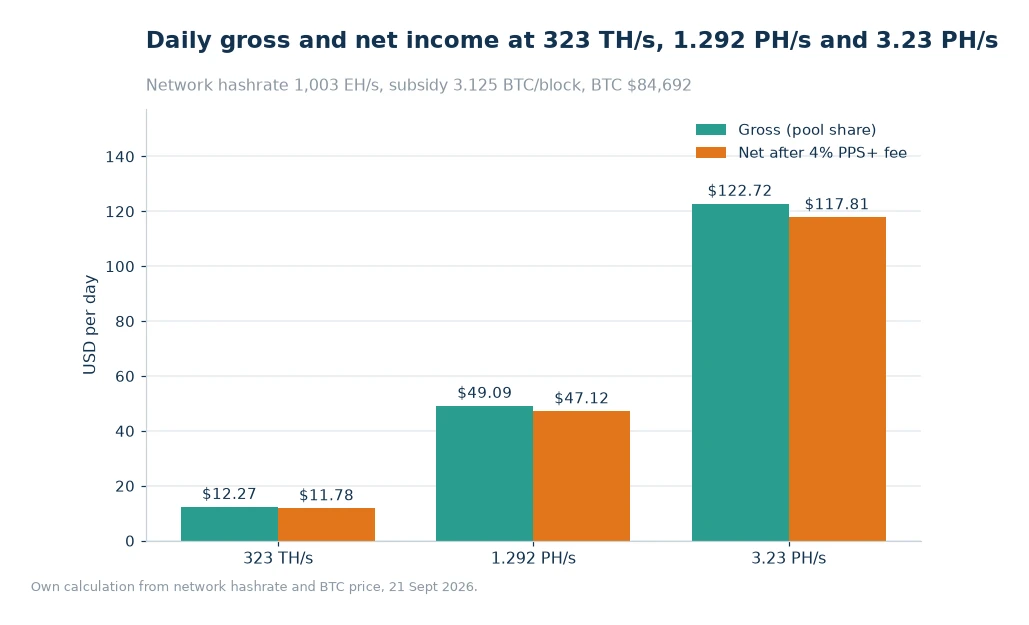
A single 323 TH/s machine nets about $11.78 a day at $84,692, so a container holding fifty of them would clear roughly $589 before its own overheads. That arithmetic is easy and misleading. The second container is not a bigger version of the first; it is a different set of fixed costs, a different failure mode and a different relationship with the grid.
Key takeaways
- One machine at 323 TH/s nets $11.78 a day; scaling to fifty multiplies the credit but not the fixed cost per unit.
- At 20 J/TH, a fifty-machine container draws about 323 kW, which is a substation conversation rather than a socket one.
- The second container adds redundancy and a second point of failure at the same time.
- Curtailment revenue can change the economics of a container more than a hardware upgrade does.
One container is a threshold, not a multiplier
Below a certain size, mining is a hobby with a power bill. Above it, the operation acquires obligations: a three-phase supply, a fire assessment, insurance that understands what is in the box, and a maintenance schedule that assumes something is always broken. The container is the physical marker of that change, but the change itself is commercial, and it happens earlier than most first-time buyers expect.
That is why comparing two containers is not the same as comparing two machines. Doubling the machine count doubles the credit and roughly doubles the power. Doubling the container count doubles the credit and adds a second set of fixed costs that do not scale linearly: the second transformer, the second fire zone, the second set of spare parts, and a second round of paperwork with the utility that has nothing to do with hashrate.
The fixed costs that arrive with the steel
A container needs a slab that can carry it, a feed that can supply it, and a clearance around it for airflow and access. Those three items are usually more expensive than the container itself and take longer to arrange. The machines are the last thing to arrive and the first thing people budget for.
There is also the question of where the heat goes. A container in a yard can exhaust into open air; a container inside a building needs ducting, and the ducting needs a path. Owners who buy the box before confirming the exhaust route tend to discover the problem on the day the crane arrives. The ViaBTC Bitcoin Mining side of the project is a login and a worker name; the building is where the months disappear.
What 323 TH/s looks like inside a container
The table scales one reference machine up to a realistic container load. Power assumes 20 J/TH, which is an assumption about the hardware generation rather than a quoted figure. The net column uses the same rate throughout.
| Machines | Total hashrate | Power draw | Net USD per day |
|---|---|---|---|
| 1 | 323 TH/s | 6.5 kW | $11.78 |
| 10 | 3.23 PH/s | 64.6 kW | $117.81 |
| 50 | 16.15 PH/s | 323 kW | $589.05 |
The third row is where the grid conversation starts. Three hundred kilowatts is not a large industrial load, but it is large enough that the utility will ask about your transformer, your power factor and your plan for the summer peak. Those answers take months, and they belong in the budget before the container is ordered.
The second container changes the shape of the risk
Two containers can be run as one logical site or as two independent ones. The first option shares switchgear, monitoring and staff, which is cheaper and creates a single point of failure. The second duplicates everything, which costs more and means a transformer fault takes down half the site instead of all of it.
For most small operators the shared arrangement is the only affordable one, and the redundancy comes from spare parts rather than from parallel infrastructure. A spare fan, a spare PSU and a spare control board per ten machines will keep a container running through most failures. A spare transformer will not fit on a shelf, which is why grid risk is better insured with a maintenance contract that states a repair window than with stock sitting in the yard.
Curtailment as part of the plan
A container is a dispatchable load, which is a useful thing to be in a market with variable prices. Turning off for a few hours at the peak costs the credit those hours would have produced and can avoid a demand charge or earn a payment for not drawing. Whether that trade is worth it depends on the local tariff structure, not on a general rule.
The arithmetic is simple enough to do per event. At 323 kW, four hours of curtailment forgoes about $98 of net credit across a fifty-machine container, while reducing the month's peak demand by 323 kW. If the demand charge is priced per kilowatt of peak, one avoided event can pay for several afternoons of lost hashing.
When the cheapest board is the wrong choice
Filling a container with the cheapest available machines minimises capital cost and maximises the power bill. In a site where the feed is the constraint, the calculation inverts: the expensive, efficient machine produces more hashrate per kilowatt, and the container's capacity is measured in kilowatts rather than in slots.
Both constraints exist somewhere. A site with spare power and cheap racking should optimise for capital cost. A site with a fixed feed and expensive upgrades should optimise for efficiency, even at a premium per terahash. Buying the cheapest board is only correct in the first case, and even then only if the maintenance burden is priced in. The mistake is to apply a rule from one site to the other because the spreadsheet looked similar.
Worked example: fifty machines in one box
The scaling is linear, which is exactly why the fixed costs deserve separate attention.
- 450 BTC ÷ 1,003,000,000 TH/s = 0.00000044865 BTC per TH/s a day.
- 323 × 0.00000044865 = 0.00014492 BTC, or $12.27 at $84,692.
- Net after the 4% block-reward charge: 0.00014492 × 0.96 = 0.00013912 BTC, or $11.78.
- Fifty machines: 50 × 11.78 = $589.05 a day, and 50 × 323 = 16,150 TH/s.
- Power at 20 J/TH: 16,150 × 20 = 323,000 W, or 323 kW.
- Daily energy: 323 × 24 = 7,752 kWh; at $0.06 that is $465.12.
- Margin before staff, rent and maintenance: $589.05 − $465.12 = $123.93 a day.
Frequently asked questions
What does a fifty-machine container return?
About $589.05 a day at 323 TH/s per machine and $84,692 per BTC, before power, rent, staff and maintenance; at 20 J/TH the box draws roughly 323 kW.
Is a second container just twice the first?
No. The credit doubles, but the second container adds its own transformer, fire zone, spares and grid approval, so the fixed cost per unit does not fall as neatly as the machine count rises.
Should I buy the cheapest machines for a container?
Only if the site has spare power; where the feed is the limit, efficiency per terahash matters more than the purchase price because capacity is measured in kilowatts.
Price the box, not the boards
Model the container as a building with a power contract attached, then add the machines as a variable cost. If the margin survives a moderate rise in difficulty and a modest fall in price, the site is worth building. The pool state page shows the network's direction and the Mining Farms listing shows what a professional site charges, which is the benchmark any do-it-yourself container has to beat.
Sources: ViaBTC pool state, farms and pricing pages, with chain data read 21 Sept 2026 — network hashrate 1,003 EH/s, difficulty 132.76 T, 3.125 BTC per block, 144 blocks a day, BTC $84,692. Efficiency and tariff assumptions are illustrative. Published 24 Oct 2026[1].