
ODM Jewelry Service Levels Compared With OEM
OEM and ODM are usually compared on price and rarely on service. The published difference is service-shaped: on an OEM job you supply the design and the factory executes it, while on an ODM job the factory also produces the concept, the 3D CAD model inside 48 hours and the physical master in 25–30 days. The floors are 100 in artisan eco-brass, 100+ pcs in stainless and 50 pcs in sterling silver, per design, applied design by design.
Key takeaways
- OEM service is execution: your CAD file in, inspected pieces out, with IP staying 100% with the client.
- ODM service adds concept development, CAD in under 48 hours and a master sample in 25–30 days.
- Both routes include a 1-on-1 project manager, a 24-hour response commitment and 100% inspection.
- Minimums are unchanged by route: 50 / 100 / 100+ pieces per design by base material.
What each route asks of your team
OEM asks for files. Somebody on your side has to produce a CAD model to a standard the factory can build from, and to answer dimensional questions inside the 48-hour window the factory works to. In exchange, the design decision never leaves your company.
ODM asks for taste and feedback. You supply a brief and a reference direction, then judge renderings and a physical sample. The cost of that convenience is that the factory's design team is inside your process, which is also the reason the published route includes a 100% NDA over moulds, CAD files and the collection.
The service level that does not change
Both routes are supported by the same published commitments: a dedicated 1-on-1 project manager, a 24-hour response, full inspection before packing and worldwide shipping with customs support. Nothing about the service offer halves because you brought your own file.
That is worth checking when comparing suppliers, because the tempting saving in a cheap OEM quote is often a reduced project management layer. A saved day of correspondence becomes two weeks of confusion when a batch needs replating.
Why the CAD stage is small but decisive
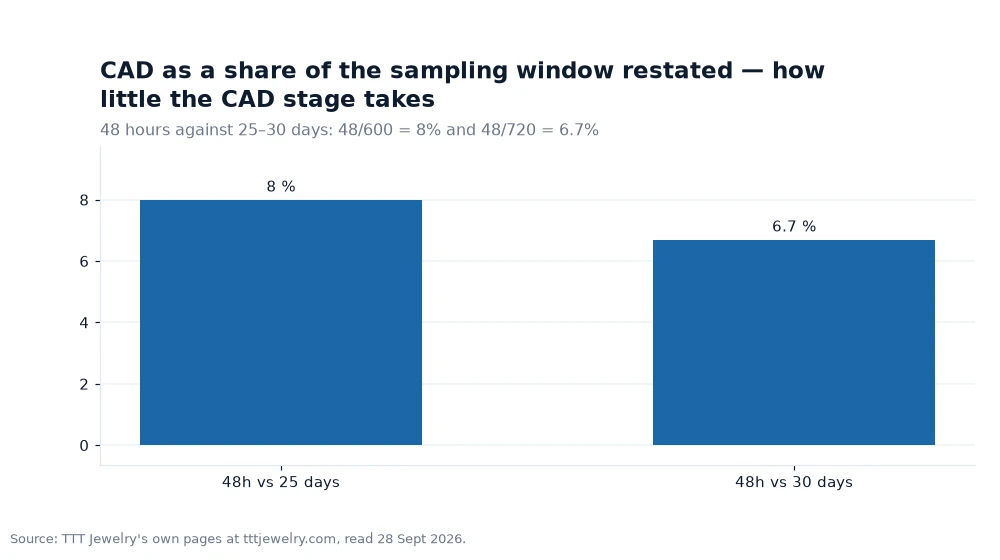
The published CAD window is under 48 hours, which is almost nothing against a 25–30 day sampling cycle. Behind this article's chart, 48 hours measured against 25 days is 48 ÷ 600 = 8%, and against 30 days it is 48 ÷ 720 = 6.7%.
Small but decisive, because it is the last cheap moment. Once the wax print exists, every change passes through casting, setting, polishing and plating again.
| Service item | OEM route | ODM route |
|---|---|---|
| Design source | client CAD file | factory concept work |
| CAD turnaround | under 48 hours | under 48 hours |
| Master sampling | 25–30 days | 25–30 days |
| Project management | 1-on-1 project manager | 1-on-1 project manager |
| Quality control | 100% inspection | 100% inspection |
The service difference that shows up months later
Ask both routes the same question: what happens if batch three is a shade off batch one? The answer depends on whether a specification was written down. A manufacturer operating a documented quality system, published as ISO 9001:2015, has a reference to compare against.
This is the point at which an OEM relationship with TTT Jewelry OEM work stops being a purchase and becomes a supply chain: the same mould, the same plating specification, the same hallmark and the same inspection gate on every reorder.
Choosing between the two on evidence, not on price
Price is the wrong comparator because the two routes sell different things. Compare instead what you would have to staff internally to reach the same result: a CAD modeller, a sample approval process and a plating specification on the OEM side, against a design brief and a review schedule on the ODM side.
The material minimums then decide the size of the bet. Silver at 50 pieces per design is the smallest launch the factory publishes, and it is available on both routes.
What an OEM buyer should have ready before the enquiry
OEM service runs on files, so the first message should carry a CAD model or a dimensioned drawing, the quantity per design, the base metal and the finish. The published process turns those inputs into a mould and a master sample inside 25–30 days.
If the drawing is not finished, the ODM route is the honest choice rather than a compromise. It replaces the file with a brief and adds concept development, which is why the published process describes ODM as you inspire, we create.
Support commitments worth checking on both routes
The published support list is the same on each route: a dedicated 1-on-1 project manager, a 24-hour response commitment, 100% inspection before packing and a 100% NDA over moulds and CAD files.
Those commitments cost the factory money, which is why they are the first things to disappear from a discounted quote. A saved project manager is not a saving when a plating question goes unanswered for a week inside a 25–30 day sampling window.
The cost of moving labour onto your own side
A discounted OEM/ODM quote usually removes something. Sometimes it removes design development, which is a fair trade if you have files. Sometimes it removes project management, a 24-hour response commitment or the inspection stage, which are not.
Estimate what the removed piece costs you internally. A project manager on your side who chases approvals through a 25–30 day sampling window is not free, and neither is a quality check performed on arrival after a 3–4 week production run has already shipped.
The published service list is worth reading as a specification. Where a cheaper quote omits an item from it, the honest question is who does that work instead.
Worked example: how little of the sampling window the CAD stage takes
Convert the sampling window into hours and compare it with the CAD slot. Twenty-five days is 25 × 24 = 600 hours, and thirty days is 30 × 24 = 720 hours.
CAD is published at under 48 hours. Against the fast end: 48 ÷ 600 = 0.08, or 8%. Against the slow end: 48 ÷ 720 = 0.0667, or 6.7%.
So somewhere between 92% and 93.3% of the sampling window is bench work in wax, metal, stone, polish and plating. A buyer who wants a faster sample should ask which of those five operations can be scheduled in parallel, not which one can be dropped.
Frequently asked questions
Does ODM come with less control than OEM?
Not over quality. Both routes run the same published inspection rule of 100% of pieces, the same studio sampling window of 25–30 days and the same 1-on-1 project management.
Who owns the design in each route?
OEM keeps intellectual property 100% with the client. ODM produces co-created collections that stay exclusive to the buyer's brand, with moulds and CAD files covered by a 100% NDA.
How fast is the first CAD drawing?
The 3D CAD model and its renderings are published at under 48 hours on both routes, which is 6.7–8% of the 25–30 day sampling window that follows.
Comparing two quotes that are not the same product
Write down what each route asks of your own team, then price that work honestly. A quote that looks cheaper usually moves labour onto your side of the table. The silver manufacturing pages show the lower minimum route in full, and the answers page covers response times and support.
The figures used above — the 100% NDA terms along with the master sample rule, the laser engraving stage — are drawn from the client's own website at tttjewelry.com, which I went through on 28 Sept 2026. The restatement in weeks is my own arithmetic rather than the manufacturer's[1].