
Seven Scenting Mistakes That Sink a Festive Home and Personal Care Range
Home and personal care look like neighbouring categories and behave like different industries. A fragrance that is beautiful in a candle can disappear in a body wash, and one that sings in a hand cream can turn heavy in a reed diffuser. Festive gifting makes this worse, because a gift set puts several formats in one box and asks them to feel like a family. Most of the mistakes below are not perfumery errors; they are assumptions carried from one format into another without being tested.
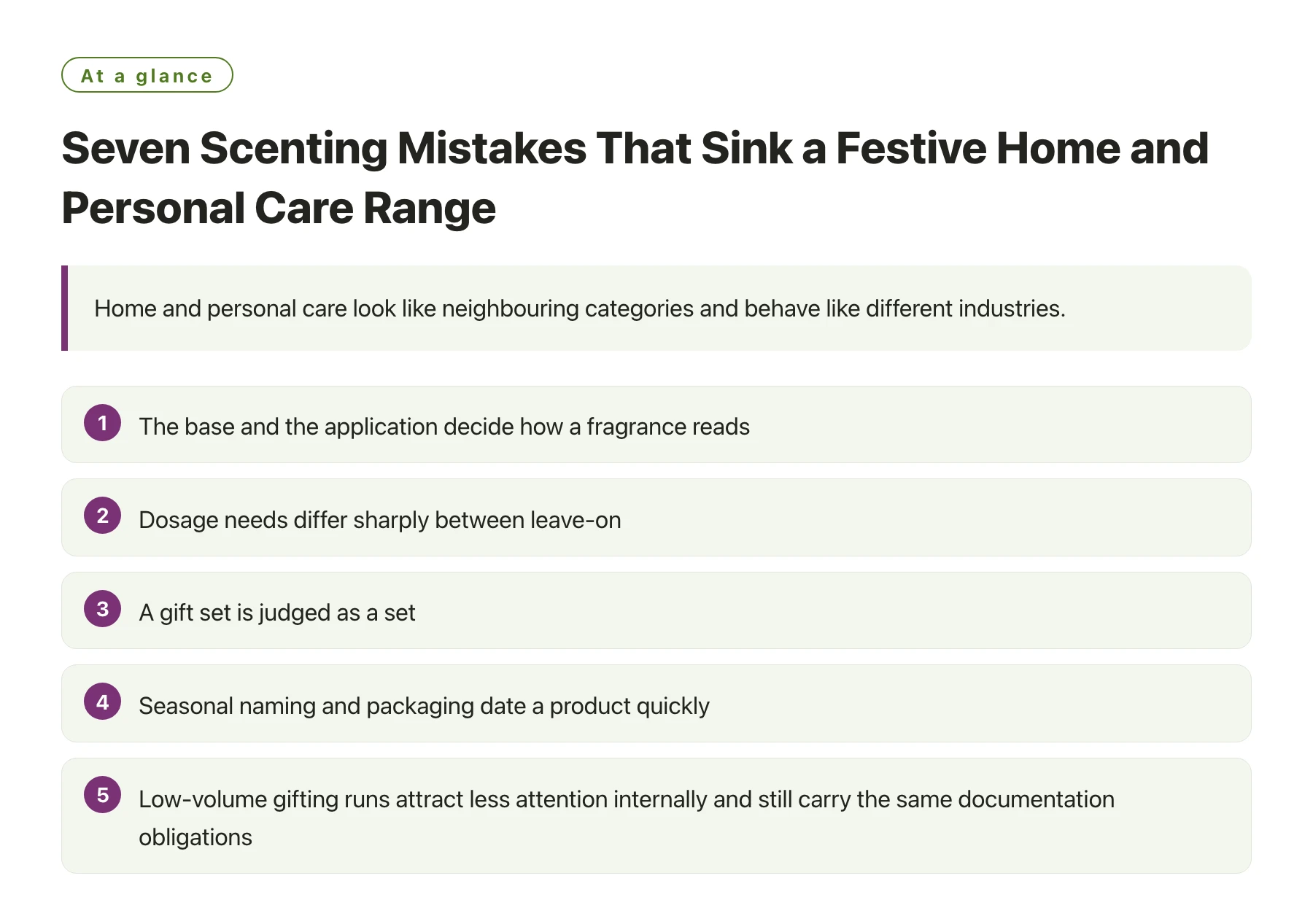
Key takeawaysThe base and the application decide how a fragrance reads, so a scent has to be evaluated in the finished format rather than on a blotter. · Dosage needs differ sharply between leave-on, wash-off and ambient products, and copying a percentage from one format to another is a common and expensive mistake. · A gift set is judged as a set, so the scents inside it have to relate to each other instead of competing. · Seasonal naming and packaging date a product quickly, so the scent itself is usually best kept broader than the occasion. · Low-volume gifting runs attract less attention internally and still carry the same documentation obligations, which is where surprises tend to surface.
Scenting decisions are usually taken by people who are good at products, not at odours, and that is fine. What causes trouble is the transfer of an assumption: because a fragrance smells right in one format, it is expected to work in the next. Home and personal care formats differ in base, in temperature, in contact time and in how the customer uses them, and each of those differences changes the result.
This article is written for product development and quality teams building a festive gifting range that mixes home and personal care items. It lists the mistakes that recur, explains why they happen, and gives the cheaper alternative in each case.
The two categories are not the same shelf
A personal care product is applied to skin and its scent develops against a base of water, oils, surfactants and preservatives. A home product is usually scenting a space, and its fragrance is released into the air through heat, evaporation or a wick. The same fragrance material can behave very differently in the two settings, because the base interacts with the fragrance, and because the way the molecules reach the nose is quite different.
There is also a regulatory difference in how the products are treated and labelled, which means a set containing both kinds of items has more than one documentation path. Manufacturers that serve both categories handle this routinely; buyers assembling a mixed set should assume it will be more paperwork, not less.
If you are sourcing the whole set from one supplier, Xuelei's official site shows how a single manufacturer describes both fragrance and personal care capabilities, and the useful question in a first call is which formats are made in house and which are bought in. The answer determines how much of the set's consistency you can hold the partner responsible for.
The practical consequence for a development team is to plan one evaluation protocol per format, not one for the scent. Same fragrance, several tests, each in the pack and base it will actually be sold in.
Seven mistakes that recur in festive gifting ranges
| Mistake | Why it happens | What to do instead |
|---|---|---|
| Testing the scent on a blotter only | Blotters are fast, clean and free of the base, so they flatter every candidate | Evaluate in the finished base and pack, at the dosage you intend to sell |
| Copying dosage from one format to another | A working percentage feels like a known quantity, so it gets reused | Ask the formulator for a starting dosage per format and confirm it by trial in that base |
| Assuming one scent suits the whole set | It is convenient commercially and it sounds coherent in a meeting | Choose a core direction plus one related variation, and check the set as a whole |
| Skipping stability and compatibility checks | The gifting calendar is short and the checks feel like a formality | Run the checks on the actual pack, and treat the results as a launch gate rather than a record |
| Letting the festive theme drive the scent | Seasonal packaging arrives first in the design process | Keep the scent readable year-round and let the packaging carry the occasion |
| Treating a small run as exempt from documentation | Low volumes feel like a pilot, so the paperwork is trimmed | Hold the same documentation standard as a core line and reuse it the following season |
| Approving components rather than the assembled set | Each supplier ships what it was asked for and nobody assembles a sample | Sign off a physical pre-production sample of the finished set, boxed and labelled |
The right-hand column is deliberately unglamorous. In gifting, most quality problems are solved by testing the object the customer buys rather than the components you ordered.
The set problem: several products, one box
A gift set is experienced as a single object. The customer opens the box, smells the first item, then the second, and forms one impression of the whole. That means two well-made products can still make a poor set if their scents clash, and it means the low-intensity item is usually the one that gets noticed first, because the nose arrives at it fresh.
The discipline is to decide the set's scent architecture before individual briefs are written. A common approach is one lead direction, one lighter support, and an ambient item that extends the lead rather than introducing an unrelated idea. Working through white label fragrance manufacturing is often enough for this kind of range, because a library scent adapted per format is cheaper and faster than developing several new directions for a single season.
It also pays to think about how much of the range will survive the season. If the set is a one-off, a library direction with adjusted dosage may be the right commercial answer. If the retailer intends to continue the line, the development investment belongs in a scent the brand can own, and that changes the brief from the start; the difference between a set and a line is worth understanding before the first sample round end-to-end fragrance development.
Where the two categories meet, watch dosage. Home products typically carry a much higher fragrance load than leave-on personal care, because they have to scent a space rather than a person, and materials that are pleasant at a low level can become dominant when the load rises. Restrictions on material use also apply per product type, so the same formula cannot simply be scaled up across formats [1].
Finally, keep a commercial view of both categories. The household and personal products industry spans segments with quite different technical and regulatory demands, and treating them as one development problem is a reliable way to lose time [2]. Split the plan, keep one owner, and hold the set together through the scent architecture rather than through short cuts.
Do one full-set sniff before the packaging order goes out. Assemble the actual items, in the actual box, with the actual labels, and smell them in the order a customer would. It takes twenty minutes, it catches clashes and dosage mismatches that no spreadsheet shows, and it is the last cheap moment to change anything.
Sources
- IFRA: Safe Use and Fragrance Science —— IFRA's explanation of how fragrance materials are scientifically assessed for safe use and how those conclusions are applied by the industry.
- HAPPI — Household & Personal Products Industry —— An industry magazine covering the household and personal care market, including fragrance, formulation and packaging.
Frequently asked questions
Can one fragrance be used across home and personal care?
It can, but it has to be tested in each base and at the dosage appropriate to each format. The same formula rarely performs identically in a candle, a diffuser, a lotion and a wash-off product.
Why does a fragrance smell different in a candle than in a lotion?
The base, the application and the way the scent reaches the air all differ. Heating accelerates the release of lighter materials, while a cream base holds heavier ones, so the balance the perfumer designed shifts.
How should a gifting set be scent-matched?
Decide the set's scent architecture first: usually one lead direction, a lighter companion and an ambient item that extends the lead. Then brief each format from that structure rather than developing items separately.
Are seasonal scents a mistake?
Not necessarily, but a scent that only reads as festive limits the product's selling life. Many brands keep the fragrance broad and put the occasion on the packaging, so unsold stock can be carried forward.
Does a small gifting run need the same testing as a core line?
Yes. Stability, compatibility and labelling obligations do not scale down with volume, and a short run with incomplete documentation tends to become a problem precisely when the range is successful enough to repeat.